
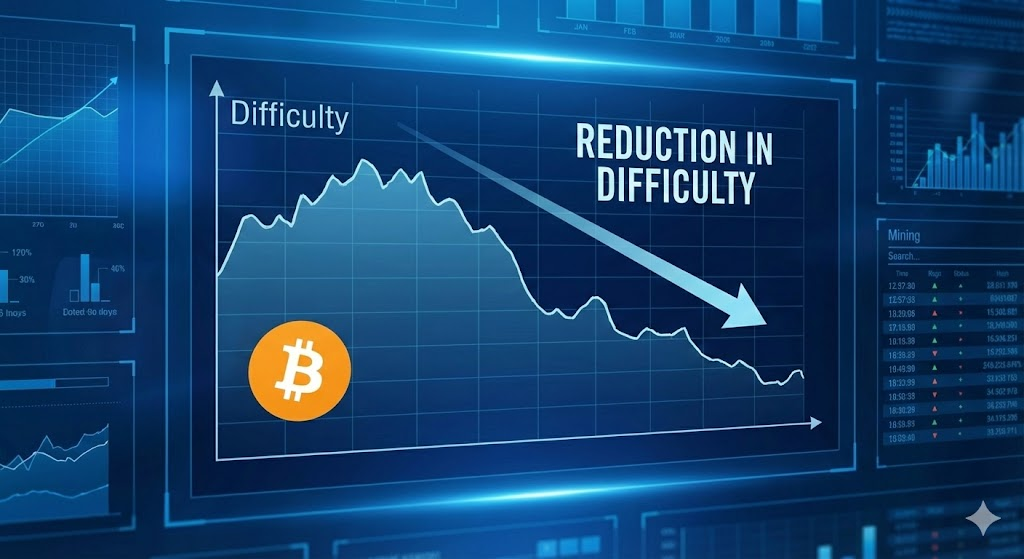
Bitcoin Mining Difficulty Reduction: What It Means for Miners
A reduction in mining difficulty for Bitcoin often attracts attention from miners, analysts, and investors alike. Difficulty adjustments are one of Bitcoin’s most important self-regulating mechanisms, yet they are frequently misunderstood. When difficulty drops, some see opportunity. Others see weakness. In reality, a bitcoin mining difficulty reduction is neither inherently good nor bad. It is a signal, one that reflects changes in miner participation, economics, and external conditions.
Bitcoin was designed to operate without central control. Mining difficulty plays a key role in that design. It ensures blocks are produced at a predictable pace, regardless of how much computing power is participating in the network. When conditions change, difficulty adjusts automatically. Understanding why those adjustments occur helps miners make informed operational decisions rather than reacting emotionally to headlines.

This article explores what a reduction in Bitcoin mining difficulty really means, why it happens, and how it affects miners in practical terms.
What Bitcoin Mining Difficulty Represents
Bitcoin mining difficulty is a measure of how hard it is to produce a valid block. More precisely, it determines how many high-speed guess-and-check attempts miners must perform to find a target, a process known as proof of work (PoW). The higher the difficulty, the more total hash power is required to find blocks at the target interval.
Bitcoin aims to produce one block roughly every ten minutes. Difficulty exists to keep that timing stable. If miners add more hash power to the network, blocks would be found faster without adjustment. Difficulty rises to compensate. If miners leave and hash power drops, blocks slow down. Difficulty falls to restore balance.
A bitcoin mining difficulty reduction is therefore a response to slower-than-target block production.
How and When Difficulty Adjusts
Bitcoin adjusts mining difficulty every 2,016 blocks. Under normal conditions, this takes about two weeks. The network measures how long it took to mine the previous 2,016 blocks and compares that to the expected time.
If blocks were mined too quickly, difficulty increases. If they were mined too slowly, difficulty decreases. There is no human intervention. The process is enforced by code and validated by every node on the network.
This mechanism ensures predictability. Even during periods of extreme volatility in price or hash rate, Bitcoin continues functioning without interruption.
Why Mining Difficulty Sometimes Drops
A reduction in mining difficulty for Bitcoin typically follows a decline in total network hash rate. Several factors can cause this.
One common cause is miner capitulation. When mining becomes unprofitable, usually due to falling Bitcoin price or rising energy costs, less efficient miners shut down their hardware. As those machines go offline, total hash power decreases, and difficulty adjusts downward.
Another factor is energy market disruption. Sudden increases in electricity prices can force miners to pause operations, especially those operating at retail rates. Hardware migration between regions also plays a role.
Regulatory action can trigger sharp difficulty drops as well. When mining bans or restrictions occur, large amounts of hash power can disappear in a short time, leading to delayed but noticeable difficulty reductions.
What a Difficulty Reduction Means for Active Miners
For miners who remain online, a bitcoin mining difficulty reduction often improves short-term economics. With fewer competitors, each unit of hash power earns a slightly larger share of block rewards.
Using illustrative assumptions at $0.085 per kWh, lower difficulty can temporarily restore profitability for efficient miners, assuming stable uptime, network conditions, and pool fees. This does not guarantee profit, but it improves odds.

However, this effect is rarely permanent. As profitability improves, miners tend to return. New hardware comes online. Difficulty rises again. The system continuously seeks equilibrium.
Difficulty Reduction and Network Security
Lower difficulty often coincides with lower total hash rate, which raises questions about security. While a drop in hash power technically reduces the cost of attacking the network, Bitcoin’s absolute hash rate remains extremely high compared to other proof-of-work chains.
In practice, difficulty reductions are usually incremental and temporary. They reflect economic pressure, not structural weakness. Historically, Bitcoin has recovered hash rate after every major downturn.
The difficulty adjustment mechanism is one of the reasons Bitcoin remains resilient under stress.
Mining Strategy During Difficulty Reductions
Experienced miners view difficulty reductions as data points, not guarantees. A lower difficulty environment can favor efficient operators with optimized power costs and reliable infrastructure.
This is where hardware quality and hosting matter. Modern ASIC miners with strong efficiency metrics perform better during transitional periods. Professional hosting and colocation setups reduce downtime and stabilize operating costs.
For miners evaluating deployment or expansion, difficulty trends should be considered alongside price, energy costs, and hardware availability.
Difficulty Reduction vs Long-Term Trends
While short-term difficulty reductions draw attention, long-term trends matter more. Over Bitcoin’s history, mining difficulty has trended upward despite periodic declines.
Each reduction reflects temporary stress. Each recovery reflects renewed participation. This cyclical pattern is normal in a competitive, incentive-driven system.
Miners who survive downturns often benefit most from subsequent recoveries, provided they manage costs and avoid overextending during peak conditions.
Conclusion
A reduction in mining difficulty for Bitcoin is not a failure signal. It is a built-in response to changing economic and operational conditions. Difficulty adjustments keep block production stable and allow the network to adapt without central control. For miners, difficulty reductions can offer short-term relief, but they should be evaluated within a broader context that includes energy costs, hardware efficiency, and market conditions. Understanding difficulty dynamics helps miners operate strategically rather than reactively.
FAQ
1. What causes a bitcoin mining difficulty reduction?
It occurs when blocks take longer than expected to mine, usually due to reduced hash rate.
2. How often does Bitcoin adjust mining difficulty?
Every 2,016 blocks, approximately every two weeks.
3. Is a difficulty reduction good for miners?
It can improve short-term profitability for active miners, but it is usually temporary.
4. Does lower difficulty mean Bitcoin is insecure?
No, Bitcoin remains highly secure even during periods of reduced hash rate.5. Can miners predict difficulty reductions?
Trends in hash rate and miner behavior can provide clues, but exact outcomes are never guaranteed.