
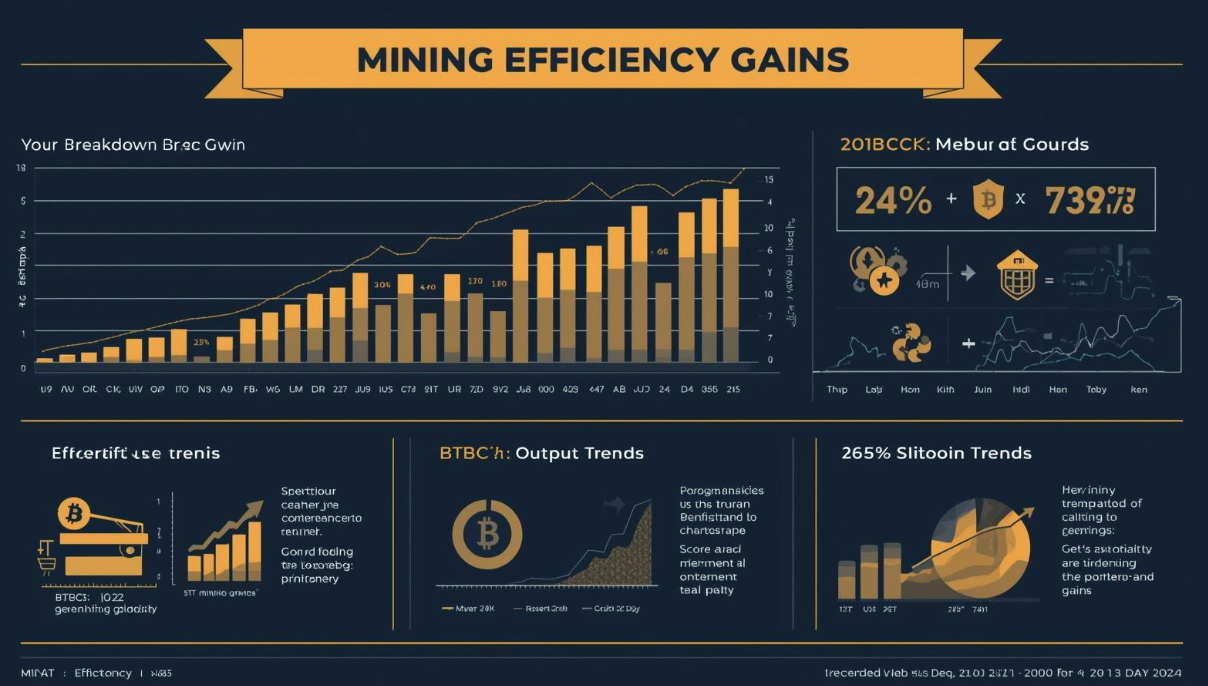
Understanding Mining Efficiency Gains Over Time
Mining efficiency gains define how well a mining operation performs as hardware evolves and network difficulty increases. Each year introduces ASICs with improved joules-per-terahash ratios, yet the objective remains the same. Miners aim to secure as much Bitcoin as possible while controlling electricity costs.
Because mining relies on high-speed guess-and-check calculations through proof of work (PoW), efficiency directly affects how many hashes can be produced per kilowatt hour. More hashes with the same power increase the probability of consistent rewards. This matters for both small home miners and larger operations.

Using an illustrative electricity cost of $0.085 per kWh, miners often evaluate yearly efficiency changes to understand how upgrades influence long-term Bitcoin accumulation. Improved efficiency stabilizes ROI estimates even as difficulty rises.
Chip-Level Improvements Driving Efficiency
Most mining efficiency gains begin at the chip level. Each ASIC generation refines transistor density, power flow, and heat control. These refinements reduce wasted energy and support steadier output.
Lower joules per terahash allow miners to operate more predictably during market downturns or difficulty increases. As a result, efficient rigs remain viable longer than older models.
Many operators pair efficient hardware with hosting and colocation through BitcoinMinerSales.com. Stable infrastructure reduces downtime and preserves consistent hash production, which is critical for yearly accumulation.
Compounding Gains Over a Full Year
Even small efficiency improvements compound over time. Reducing power draw by a few hundred watts per unit can materially improve yearly results at $0.085 per kWh.
Although ROI figures remain illustrative, they help miners plan refresh cycles and scaling decisions. Year-over-year data highlights which rigs perform best under sustained load and stable environments.
With a wide range of ASIC models available from BitcoinMinerSales.com, miners can now choose from clear efficiency tiers suited to long-term strategies.
Mining Efficiency Gains and Yearly Power Trends
Yearly power trends shape how miners manage operating budgets, especially when electricity rates remain fixed. Mining efficiency gains often stem from better chip architecture and thermal design.
Lower joules per terahash reduce energy cost per unit of work. This allows rigs to remain profitable longer as network conditions tighten.
Power Cost Stability and Planning
Electricity remains one of the largest mining expenses. Using a standard assumption of $0.085 per kWh helps miners compare performance across different setups.
As new hardware becomes available from BitcoinMinerSales.com, miners conduct year-over-year comparisons to evaluate real-world efficiency. Units that handle temperature swings well retain performance during seasonal peaks.
Better stability improves annual accumulation, which is why many miners upgrade when new generations become available. Enterprise clients may qualify for reduced rates, but the retail benchmark keeps analysis consistent.
Firmware and Yearly Performance
Firmware optimizations also contribute to yearly efficiency gains. Some miners reduce power draw through firmware tuning while maintaining competitive hash rates.
Over many months, these adjustments create measurable differences in total Bitcoin output. Miners who refresh hardware every two to three years often see steadier performance.
Hardware available from BitcoinMinerSales.com gives operators flexibility to match efficiency goals with budget constraints.
Comparing Efficiency Across ASIC Hardware Generations
Each ASIC release cycle reshapes the mining landscape. Newer generations typically offer lower power consumption, better cooling, and improved reliability.
Earlier ASICs often required frequent airflow adjustments. Newer units from BitcoinMinerSales.com integrate refined heat sinks and stronger fans, allowing stable output across wider conditions.

Managing Hardware Aging
Efficiency declines naturally as ASICs age. Dust, thermal cycling, and fan wear gradually reduce performance.
By comparing yearly efficiency gains, miners can plan replacement timelines more accurately. This prevents running rigs beyond their competitive window.
When difficulty rises, efficient rigs maintain output while older units struggle at $0.085 per kWh.
Hosting and Environmental Control
Hosting and colocation through BitcoinMinerSales.com help preserve long-term efficiency. Controlled airflow and industrial cooling reduce heat stress.
Miners comparing multiple generations over a year gain insight into how rigs handle load stress and seasonal changes. Efficient units also retain resale value longer when upgrading.
Efficiency Gains and Yearly Bitcoin Accumulation
Mining efficiency gains directly affect yearly Bitcoin accumulation. Producing more hashes per watt increases the chances of earning block rewards over time.
Even a 200-watt reduction in power draw can save hundreds of dollars annually. Those savings contribute directly to net BTC output.
Uptime and Hardware Longevity
Better efficiency also extends hardware lifespan. Cooler operation reduces fan failures and power supply stress.
Downtime is costly. Every hour offline reduces yearly revenue. Hosting and colocation through BitcoinMinerSales.com help maintain consistent uptime by managing cooling and power stability.
Strategic Upgrade Planning
Many miners refresh 20 to 30 percent of their fleet annually. Others evaluate whether older rigs remain profitable under their power cost constraints.
Efficient hardware from BitcoinMinerSales.com allows miners to stay competitive even as older models fall out of profitability. Over a full year, efficiency gains build predictable performance curves that support long-term scaling plans.
Conclusion
Mining efficiency gains shape the trajectory of long-term mining operations. As ASIC technology improves, miners benefit from better joules-per-terahash ratios, cooler operation, and reduced downtime.
Hosting and colocation through BitcoinMinerSales.com preserve these gains by providing stable environments that extend hardware lifespan. By tracking yearly trends and comparing ASIC generations, miners can build strategies that maximize Bitcoin accumulation.
Although ROI estimates remain illustrative at $0.085 per kWh, the long-term pattern is clear. Efficient hardware consistently outperforms less efficient models over extended periods.
FAQ
1. How do efficiency gains affect yearly Bitcoin accumulation?
They allow miners to produce more hashes per watt, reducing costs and increasing yearly output.
2. Why does power cost matter when evaluating ASIC performance?
Power cost directly impacts profitability because mining requires continuous energy consumption.
3. How often should miners upgrade hardware?
Many operators upgrade every two to three years, depending on efficiency and power costs.
4. Does hosting improve long-term performance?
Yes. Hosting and colocation through BitcoinMinerSales.com reduce downtime and stabilize output.
5. Are ROI estimates guaranteed?
No. ROI at $0.085 per kWh is illustrative and depends on difficulty, uptime, fees, and Bitcoin price.